So… There is another Fire Safety related Regulation brought in, and as a responsible and/or accountable person it must seem like it’s impossible to keep up! Not only was there two brand new British Standard Code of Practices brought in late 2025 which affect Fire Risk Assessments and Assessors, there is now this Fire Safety (Residential Evacuation Plans) (England) Regulations 2025 to comply with, which as of the 6th April 2026 has come into force.
Fear not, Kaden Fire Safety have you covered. In this article we are going to take a look at this new regulation and see what exactly it is trying to regulate.
These Regulations are made under article 24 of the Regulatory Reform (Fire Safety) Order 2005 (“the Fire Safety Order” or “FSO”), which enables the making of regulations regarding precautions to be taken or observed in relation to the risk to safety of persons from fire in premises to which that Order applies.
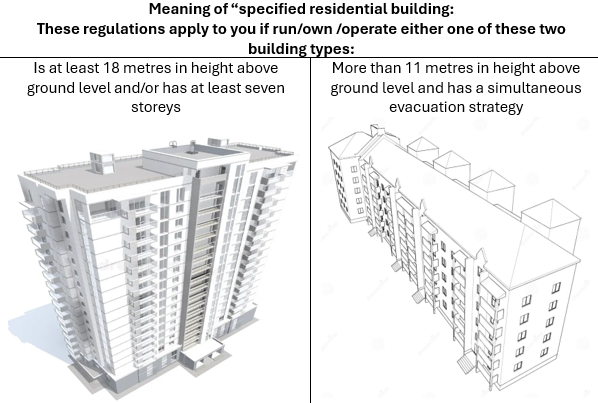
“In simple terms, this means that if you have a building which fits the criteria specified, then these regulations apply to you”.
These Regulations make provision for personal and building emergency evacuation plans in relation to specified residential buildings.


The Fire Safety (Residential Evacuation Plans) (England) Regulations 2025 consist of 4 parts and 14 sections.
Part 2 Residential personal emergency evacuation plans,
Part 3 Building emergency evacuation plan, and
Part 4 Amendment of the Fire Safety (England) Regulations 2022
Part 1 sets out definitions used in these Regulations.
Regulation 4.Meaning of “relevant resident”
(a)who is a resident of domestic premises in a specified residential building, where the domestic premises are that person’s only or principal residence, and
(b)whose ability to evacuate the building without assistance in the event of a fire is compromised as a result of a cognitive or physical impairment or condition.
“In simple terms it means any resident who has it as their primary residence and requires help/assistance self-evacuating”.
Commencement Information
Reg. 4 in force at 6.4.2026, see reg. 1(2)
Part 2 Residential personal emergency evacuation plans
Sections 5 – 12
5.Identification of relevant residents
6.Person-centred fire risk assessment
8.Emergency evacuation statement
9.Review by the responsible person
10.Provision of information to local fire and rescue authority
Part 2 sets out the residential personal emergency evacuation plan process.
It makes provision requiring the responsible person (defined in article 3(b) of the Fire Safety Order in relation to specified residential buildings) to identify residents with cognitive or physical impairments that may affect their ability to evacuate a building in the event of a fire (regulation 5) and to undertake a person-centred fire risk assessment for any such resident that requests it (regulation 6).
Regulation 5 explained: The responsible person in relation to a specified residential building must use reasonable endeavours to identify relevant residents of that building. This is open to interpretation, however a competent fire risk assessor will be able to specify what “reasonable endeavours” should look like depending on building height, risk level, complexity, evacuation (if above 18m and/or 7 storeys) and occupancy demographic.
Commencement Information
Reg. 5 in force at 6.4.2026, see reg. 1(2)
In simple terms Regulation 6 explains that an RP must perform a Person-Centred Fire Risk Assessment. This means:
Commencement Information
Reg. 6 in force at 6.4.2026, see reg. 1(2)
It also makes provision relating to measures to mitigate any risks identified (regulation 7) and for the responsible person to agree with the resident an emergency evacuation statement (regulation 8).
In simple terms Regulation 7 explains how to regulate; Mitigation of Risks
Commencement Information
Reg. 7 in force at 6.4.2026, see reg. 1(2)
Regulation 8 explains that the RP must record and create an Emergency evacuation statement.
The responsible person must, taking into account the risks identified in the person-centred fire risk assessment and any mitigating measures that are to be implemented under regulation 7—
(a)use reasonable endeavours to agree with the relevant resident the approach to the resident’s evacuation in the event of a fire, and
(b)where the approach is agreed—
(i)record the approach in a statement in writing (an “emergency evacuation statement”), and
(ii)provide the relevant resident with a copy of the emergency evacuation statement.
Commencement Information
Reg. 8 in force at 6.4.2026, see reg. 1(2)
Regulation 9 provides for review of the person-centred fire risk assessment, mitigating measures and emergency evacuation statement.
In simple terms Regulation 9 regulates the review process of person centred risk assessments by the Responsible Person/s.
Commencement Information
Reg. 9 in force at 6.4.2026, see reg. 1(2)
Regulation 11 provides for the responsible person to conduct the process with the relevant resident’s representative in specified circumstances.
In essence this regulation assists to define what a Relevant Resident’s Representative is. In certain regulations, a reference to a relevant resident also includes their representative.
Commencement Information
Reg. 11 in force at 6.4.2026, see reg. 1(2)
Regulation 12 clarifies that the duties and powers imposed and conferred by the Regulations must be exercised in accordance with data protection legislation.
In essence this regulation applies to any duty or power to process information under these Regulations.
Nothing here overrides data protection law: the Regulations do not require or allow processing information in a way that would break data protection legislation.
However, the duties or powers under these Regulations should be considered when deciding whether processing information complies with data protection law.
Data protection legislation has the same meaning as in section 3 of the Data Protection Act 2018.
Commencement Information
Reg. 12 in force at 6.4.2026, see reg. 1(2)
Part 3 requires a responsible person to prepare a building level emergency evacuation plan, and provides for review of that plan.
Regulations 10 and 13 provide for the provision of information relating to personal and building emergency evacuation plans to the local fire and rescue authority.
Regulation 10 in essence regulates the Provision of information to local fire and rescue authority by the RP.
Provision of Information to the Local Fire and Rescue Authority
Commencement Information
Reg. 10 in force at 6.4.2026, see reg. 1(2)
Regulation 13 helps regulate what a Building Emergency Evacuation Plan should include;
Commencement Information
Reg. 13 in force at 6.4.2026, see reg. 1(2)
Regulation 14 makes a consequential amendment to the Fire Safety (England) Regulations 2022.
Simply put, this regulation makes an amendment of wording within the Fire Safety (England) Regulations 2022.
Commencement Information
Reg. 14 in force at 6.4.2026, see reg. 1(2)
In Summary
As we can see, when broken down you can quite easily see and work out;
1. What building types these regs apply to,
2. Who these regulations are aimed at,
3. What these regulations are attempting to regulate, and
4. How do these regulations aim to do this?
The Fire Safety (Residential Evacuation Plans) (England) Regulations 2025 when broken down enable the RP of applicable buildings to fully understand how to account for any cognitive or physical disability a resident might have, how to assess this versus the building, its design, features, complexity, height, any active and/or passive fire protection installations/provisions etc and risk rating from the FRA.
By following the sections 1 – 14, parts 1 – 4 and satisfying each applicable regulation stated within each section, the RP/s will be compliant with these regulations. This in turns results in improved life safety in the event of a fire.
Kaden Fire Safety brings frontline operational experience to life safety!
At Kaden Fire Safety, we specialise in life safety and understand the serious consequences when things go wrong. Our company is made up of former and serving firefighters and officers, giving us unique insight into fire behaviour and evacuation requirements at real residential building fires.
We are experts in life safety risk assessments and can support you, as the Responsible Person, in developing the policies and assessments needed to comply with The Fire Safety (Residential Evacuation Plans) (England) Regulations 2025.
Fire risk assessments are no longer judged solely on whether one exists — they are
judged on who carried them out and whether they were competent to do so. BS 8674:2025 sets out the nationally recognised framework for the competence of
individual fire risk assessors.
While not law, it is rapidly becoming the benchmark used by enforcing authorities, insurers, and courts when assessing whether responsible persons have met their legal duties. Kaden Fire Safety have risk assessors on IFSM’s NFRAR (National Fire Risk Assessors Register) and validators who can undertake foundation level to advanced level FRAs and we are aligned with BS 8674:2025.

As a company comprising of BAFE SP205 scheme approved validators Intermediate & advanced-level fire risk assessors, our approach is built around:
Our service is designed to protect you not just operationally — but legally, should your fire risk assessment ever be scrutinised. Because the real test of a fire risk assessment is not the day it’s written — it’s the day it’s challenged.