



Kaden FlatSafe is an independent pre-purchase fire safety due diligence service for flat buyers, leaseholders, and estate agents across England.
Buying a flat means buying into the wider building. You become what is called a “Duty-Holder” under Article 5 of the Regulatory Reform (Fire Safety) Order 2005, potentially becoming jointly responsible for fire safety deficiencies within the wider building.
Unexpected remediation costs and compliance failures can lead to significant financial exposure for leaseholders.
Kaden Fire Safety Consultants Ltd provides professional pre-purchase fire safety reviews to help buyers understand potential risks before committing to a purchase.
Many buyers are unaware that purchasing a flat may also involve shared responsibility for:
Our independent pre-purchase reviews help buyers understand potential risks before exchange or completion.
This tailorable service is designed for:
First-Time Buyers
Understand the building before you commit financially.
Leaseholders
Identify potential liabilities and compliance concerns.
Estate Agents
Provide buyers with greater transparency and confidence.
Conveyancers & Mortgage Advisors
Support informed decision-making during transactions.
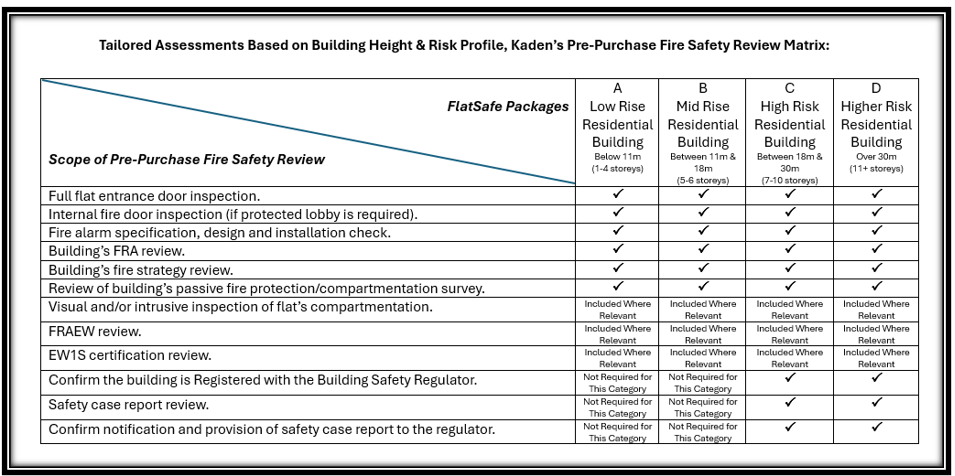
Low Rise Residential Buildings
(Below 11m or 1–4 Storeys)
Includes:
Included Where Relevant
Mid Rise Residential Buildings
(Between 11m–18m or 5–6 Storeys)
Includes:
Everything in Package A plus:
Included Where Relevant
High Risk Residential Buildings
(Between 18m–30m or 7–10 Storeys)
Includes:
Everything in Package B plus:
Included Where Relevant
Higher Risk Residential Buildings
(Over 30m or 11+ Storeys)
Includes:
Everything in Package B plus:
Included Where Relevant
Our Pre-Purchase Fire Safety Checks include include a range of the following:
Fire Risk Assessment (FRA) review
A written Fire Risk Assessment is now a legal requirement for all non-domestic premises and applicable dwellings under Article 9 of The Regulatory Reform (Fire Safety) Order 2005 (FSO).
A Fire Risk Assessment involves a thorough evaluation of premises to identify fire hazards, assess the risk of a fire occurring, and recommend appropriate fire safety measures. The assessment should be conducted by a competent person who possesses the necessary knowledge, skills, and experience in fire safety.
It’s important to note that the responsibility for ensuring fire safety lies with the “responsible person,” who is typically the employer or the person in control of the premises, who must ensure that a fire risk assessment is carried out, implement the recommended control measures, and regularly review and update the assessment. As a duty holder this may affect you.
Non-compliance with fire safety regulations in the UK can result in legal penalties, including unlimited fines and/or imprisonment, and can have serious consequences in terms of the life safety of occupants and property.
Click here to learn more about fire risk assessments.
Click here to learn more about fire risk assessor competency and the newly introduced British Standard. 8674:2025.
click here to learn more about the new code of practice for fire risk assessments in housing – BS 9792:2025.
Fire Strategy Report (FSR) review
A fire strategy is a complex document specifically tailored to a building, reviewing all aspects of the building’s fire safety features including construction, compartmentation strategy, means of escape and other fire safety features/ measures – including management arrangements in place to ensure it is fit for use for the end user of the premises or intended purpose group.
Approved documents are used predominantly as guidance for achieving the requirements of the Building Regulations for new residential and commercial buildings. Alternatively, associated approaches may be used such as that described in BS 9999, or a fire engineered approach in developing a fire strategy for a premises.
Where a building is erected or extended, or has undergone a material change of use, Regulation 38 of the Building Regulations requires that a package of fire safety information must be assembled and given to the responsible person of the premises. A fire strategy is commonly used as a means for collating and providing that information – albeit in many circumstances such information is sadly not provided.
Many owners now commission retrospective strategies to fill gaps in safety documentation, especially following recommendations from the post-Grenfell Hackitt Review.
Additionally, it guides fire safety management, including evacuation procedures, staff training, system maintenance, and compliance with fire risk assessments.
Fire Risk Appraisal of External Walls (FRAEW) review
A fire risk appraisal of external wall construction following the methodology set out in PAS 9980:2022.
PAS 9980:2022 is a code of practice which sets out a method for competent professionals to conduct Fire Risk Appraisals of External Wall construction (FRAEW) for existing multi-storey, multi-occupied residential buildings.
Many buildings will not require an FRAEW. All multi-occupied residential buildings with 2 or more sets of domestic premises now require the Fire Risk Assessment required under the Regulatory Reform (Fire Safety) Order 2005 (the Fire Safety Order) to include an assessment of their external walls. In many cases, this is will not require a detailed review of their external walls. This is now a legal requirement under The Fire Safety Act 2021 to include an assessment of the appraised external fire risk spread within an FRA.
It should be obvious to a competent fire risk assessor that the risk of fire spread, particularly in buildings with brick or masonry walls, is sufficiently low that an FRAEW is not required. In these cases, the fire risk assessor will normally address compliance of external wall construction with the Fire Safety Order as part of the routine Fire Risk Assessment process.
An FRAEW is applicable where the risk is known, or suspected, to arise from the form of construction used for the external wall build‑up, such as the presence of combustible materials.
External Wall System form 1 (EWS1) review
An EWS1 certificate is an External Wall System Fire Review certificate.
They come into play when a leaseholder is buying or selling or re-mortgaging an apartment in a multi-storey multi-occupied residential building.
It is not a building safety certificate or a legal requirement. It is a mortgage valuation tool. EWS1 certificates are not issued by the Fire Brigade.
The Royal Institute of Chartered Surveyors (RICS) and mortgage lenders jointly created the EWS1 form. It was launched in December 2019 as a way for mortgage lenders to assess the external wall safety of buildings over 18 meters.
It helps them decide whether to offer a mortgage on any given apartment within multi-storey, multi-occupied residential buildings.
Over time, they have been used for buildings under 18 meters. This reflects the Government’s Building Safety guidance published in January 2020 which applies to buildings of any height.
The certificate gives two main options & 5 ratings:
Full inspection of your flat entrance door
Fire door compliance is not optional—and it is not based solely on building height. It is a fundamental requirement under UK fire safety legislation and plays a critical role in protecting lives and property.
Under the Regulatory Reform (Fire Safety) Order 2005, several key articles must be satisfied:
Internal fire doors (if protected lobby is required due to design code)
If the furthest point in your flat is more than 9m from your flat entrance door, your flat must be provided with a protected corridor up to 9m in length.
As such all internal doors which lead onto this protected escape route must be fire door sets/assemblies in Accordance Approved Document B Volume 1 Appendix C.
Although not a responsibility of the Responsible Person for the building, the design codes will only state a requirement to install a fire rated door set/assembly where one is required due to a life safety risk.
The choice to use these doors is yours, but they should be provided for.
Passive fire protection & fire stopping
If fire stopping was required at time of construction or after works have been performed such as installing new pipes or data cables, it is crucial that all services are fire stopped compliantly to ensure that the intended fire protection afforded by the substrate element is maintained.
If non-compliant systems and/or products are used then non-compliant systems and installations are likely to fail endangering life and causing life risks which must be remediated.
If common throughout the building, these costs are generally divided by all leaseholders.
We review all fire stopping records to ensure compliant philosophy, design, materials used and installation is compliant.
Compartmentation requirements of compartment boundaries
Just as ships are designed with watertight compartments to prevent sinking if one section floods, buildings should be designed with fire and smoke resistant compartments to ‘compartmentalise’ a fire to compartment of origin and prevent it from spreading throughout the building.
Effective compartmentation is a fundamental principle of building safety. It helps protect life, supports safe evacuation, and limits damage by containing fire and smoke within defined areas.
A compartmentation survey can be used to see how the fabric of the building will likely behave in a fire.
Legal framework
The Building Act 1984 provides the framework for Building Regulations.
It also establishes Approved Documents as guidance for compliance. The Act has been updated over time, notably by the Building Safety Act 2022, which introduced stricter controls for higher-risk buildings and created the Building Safety Regulator.
While the Building Act 1984 deals with the construction and design phase, the Regulatory Reform (Fire Safety) Order 2005 (FSO) covers fire safety during the occupation of most buildings.
Confirmation of Registration of Higher-Risk Buildings
The Building Safety Act 2022 (BSA) & The Building Safety (Registration of Higher-Risk Buildings and Review of Decisions) (England) Regulations 2023, requires that all higher-risk residential buildings (HRRBs) be registered with the Building Safety Regulator (BSR) before they become occupied.
This includes buildings that are taller than 18 meters or have seven or more storeys with two or more residential units.
Safety Case Review
A safety case report sets out the building safety risks of a high-rise residential building and how they are being managed.
A high-rise residential building has at least:
Building safety risks are the risk of:
The building must be registered with the Building Safety Regulator (BSR) before people live there. These buildings are known as higher-risk buildings under the Building Safety Act 2022.
You must send BSR a copy of your safety case report:
To help identify the latest version of your report, include a date, or version number, or both.
Other legislative and/or regulatory requirements based upon height.
With increased height comes increased control measures, fire protection and/or active fire protection installations and systems.
It’s not just physical items, different pieces of legislation and regulations state different managerial requirements. We will assess historic attitude towards fire safety within the building which will help formulate any associated risks.
How can Kaden Fire Safety Consultants Ltd help?
Regarding your Kaden FlatSafe Package and assisting you with you pre-purchase due diligence:
*Independent, competent and professional reviews
*Specialist fire safety expertise
*Clear and practical reporting
*Height-specific review packages
*Professional support before purchase
Regarding assessing your building’s current associated risk level & Documentation review process:
Fire risk assessments are no longer judged solely on whether one exists — they are judged on who carried them out and whether they were competent to do so.
BS 8674:2025 sets out the nationally recognised framework for the competence of individual fire risk assessors. While not law, it is rapidly becoming the benchmark used by enforcing authorities, insurers, and courts when assessing whether responsible persons have met their legal duties.
Kaden Fire Safety have risk assessors and validators who can review foundation level to advanced level FRAs and we are aligned with BS 8674:2025.
Our Alignment with BS 8674:2025, NFRAR registration and BAFE SP205 scheme certification.
As a company comprising of BAFE SP205 scheme approved Intermediate & advanced-level fire risk assessors and validators, our approach is built around:
*Aligning assessor competence with the complexity and risk profile of your premises,
*Ensuring all assessors are on the National Fire Risk Assessors Register (NFRAR).*FRA & documents reviewed and validated by a 3rd party certified validator of the appropriate level of competency required.
*This review however does not come with any 3rd party certification from BAFE under the SP 205 scheme.